We are still looking at systems and this week, we’ll dive into weekly points.
Weekly Points
Weekly Points? That sounds trivial doesn’t it? On the surface, it might seem so, but a Guide, who is a Gamemaker, will treat all the tools with respect. Weekly points is a fantastic balancing ball to indicate effort, risk, and reward. Balancing it right makes the game interesting and meaningful.
Here’s an example. Take the game of Quidditch in Harry Potter. There are actually two games running concurrently. First, the normal game between the teams involving 10 points per goal. Second, which is far more exciting and dangerous, involves the Golden Snitch. If a Seeker catches the Snitch, his team wins 150 points and ends the game.
From Quidditch, you can see why placing points in game rules can be an art that excites people. So, how are Points designed at Acton Academy?
A Way to Inspire Motivation & Hard Work
First, all points are eventually converted into Eagle Bucks. It is the currency that drives both extrinsic motivation and accountability at Acton Academy. And the Eagle Bucks are tied to actual currency spending on goodies, experiences, and all things fun. We also allow Eagles to convert Eagle Bucks into donations to their charity of choice. In short, Weekly Points matter to the Eagles.
Here’s how Guides design the Weekly Points:
The base game: using Weekly Points as a measure of effort. We tried to link 20 points to an hour’s effort of focused work. In most cases, we tie this in with actual results in learning or completing a challenge. This data is recorded in the Journey Tracker, a software that manages goal setting & workflow at Acton Academy. The data is useful in reflecting Eagles’ efforts in different forms of work, ranging from maths, writing, reading, project work, and so on.
The Weekly Points also keep Guides focused on offering challenges which take a reasonable amount of effort to complete. On average, the Middle School Eagles have 25 hours (or 500 points) of work weekly. The deliberate calculation of weekly points also ensures certain balances in our learning design.
Then, there are the bonuses—the Snitch. When we have competitions or challenges that are particularly challenging, we might add special Weekly Points to those. It can be up to 200 points for some crazy challenge because it takes a Heroic effort. In Game Design, we call this “The Boss Level”—a very hard but rewarding journey that keeps people playing & engaged towards excellence.
A Guide who is conscious of the Game will keep a balance between a reasonably achieved effort-based Weekly Points system and pop in pleasant surprises of mastery-based Weekly Points along the way. It is because of the potent mixture of these two elements that the Eagles look forward to playing the game, much like Harry Potter in the game of Quidditch.
Weekly Updates
Preschool / Spark Studio (PS) Update
Building Aeroplanes
“Come on Arden, let’s build an aeroplane!” said Ari. This week began with Ari leading Arden to build an aeroplane using tires, planks and cones. Ari made sure that it was done just right and Arden followed his lead, trusting his fellow Eagle. After they had completed it, they realised that it was not much fun with just the two of them, so Ari called out to invite the other Eagles to join in and assigned them to their seats. Whoosh!
Building Tents
The Eagles practiced setting up camping tents and starting a fire. On the first round, the Eagles seemed a little tired and uninterested. Only a few Eagles like Adelle, Ari and Aarav kept working at it.
On the second round, the Eagles pretended to be on a camping trip. They set up a tent and started a fire. Arden took the lead in starting the fire after many attempts by other Eagles. Ari led in the tent setting. When all the hard work was done, the Eagles started to play and were deeply engrossed in exploring their surroundings. It’s unique to observe how a familiar environment can be so different to those who look at it with fresh eyes. The Eagles enjoyed digging a hole in the ground and playing “house” in the tent.
We may be small, but we CAN get this up!
It’s sparking!!!
Let’s make it into a pretty pattern!Mmmm … veges are yummier in the wild!
Elementary Studio (ES) Update
Survival Quest: Building a Shelter (Tent)
Shelter is very important in the wild, so this week the MS quest leaders focused on building tents. Everyone brought in a tent and, through attentive listening, following steps and determination, learnt to pitch them. There was plenty of teamwork too! Let’s hope they remember all their tent-pitching skills come camp time!
“You know what? I can set up my tent in 10 minutes and I can help you with setting yours up, too!”
Vegetation Still
The question was, “How can we get water from plants?” The answer: Use a vegetation still. The children were fascinated to discover that they could use the respiration process of plants to create water. It took a long time to collect a significant amount of water, however, and Kaleb said, “I prefer to collect rain water because it is faster!”
“Let’s check if we get water from the leaf.”“See what I have! Water, and its sour!”
First Aid Knowledge
Anything can happen out in the wilderness and, as every Boy Scout knows, it’s good to Be Prepared. The ES Eagles learned the basics of First Aid on Friday when the MS Eagles in charge of this week’s challenges held a team building and memory game event. The ES Eagles had fun and learned a lot of useful information! Jasmine told her mum, “If somebody is unconscious, roll them onto their side so that their tongue won’t block their breathing.”
If you can only bring one item from this board, what would you bring?
Team Building
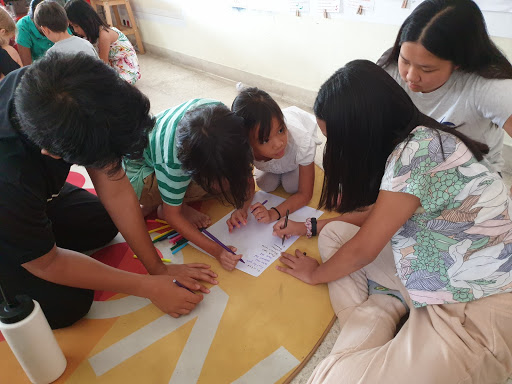
To get the team back into a cohesive unit again, an encouraging Team Building Session was held. The ES Eagles teamed up to work on their team goals and support each other in earning back their Freedom Levels. Go, teams, go!
This is the goal setting checklist of one of the teams. They will use it to encourage and ground each other. goalsettingFTW#
Survival Quest: Building a Shelter (Bamboo)
The ES Eagles also learned to build shelter from bamboo, in case they ever needed shelter but didn’t have tents. A handy skill to have!
Saw the bamboo.Set it up.
Make sure it’s tightly bound together.
Middle Studio (MS) Update
Survival Quest: Building a Shelter (Bamboo)
The MS Eagles in charge of the quest this week researched and led the ES and MS studios to build shelters from scratch using only bamboo sticks, string and plastic sheets. They discovered that while it takes very little to build a shelter as a basic need, it takes more to build a home for comfort and convenience. Katelynn made another observation: “While you camp and prepare for camp, what are some ways you can be more environmentally conscious?”
Digging a Hole
Now that the Eagles have tackled how to make fire, they decided they needed to figure out how to make a fire pit. Lots of muscles were put into good use to dig, dig, and dig, but engineering also needed to come into play to shore up the soil on the sides of the pit.
Digging for gold? Well, yes, the edible kind.Shoring up the sides of the pit.Mmmmm … what’s cookin’, good lookin’?BEGGAR CHICKEN!!It’s also good to know how to extinguish the fire safely!
KL Outing Challenge 1: A Ride on the LRT
This week the MS Eagles headed out for their KL Outing Challenge No. 1. The trip was to … the LRT station! They decided that this was a good step to take since they might have to take the LRT to their upcoming apprenticeships.
The adventure included charting out a plan for the journey, researching into public transport prices and the time they would have to spend on a round trip.
They found themselves lost in an unfamiliar place after the LRT ride, regrouped themselves and their thoughts, studied their plans and maps, and resumed their journey, with nothing but faith in their own research that they would reach the destination eventually … and they did! In reflection, Dhanya mused, “In life, should we wait for others or go forward alone, so that we can achieve our dreams?” On this outing, waiting for others instead of going it alone worked, but does it always work in different scenarios?
Onwards and upwards.Waiting … waiting … waiting …We should be here, but we’re here.We’re in it together!
First Aid Practical Training
The MS and ES Eagles had mixed feelings about going back to school on an early Saturday morning, but any misgivings were quickly erased when they arrive at the scene. Had they walked into the scene of a tragic accident?? There were bodies strewn about, severed limbs and red gooey … stuff. Mr. Chan from the Malaysia Red Crescent really knew how to catch their interest to focus on first aid!
They’re so life-like … they aren’t real, are they????Oh, they’re not real … they’re rubber!
Emergency situations don’t wait for anyone. Different emergencies were acted out for real and the Eagles were coached on how to deal with them. First off, the basics. When you see danger, what would you do? Follow the steps, of course!
1. Danger
2. Response
3. Shout for help
4. Check airway
5. Check for breath
6. Check for circulation. If there is no breathing and no circulation then we have to start CPR.
CPR (Cardio-Pulmonary Resuscitation)
CPR on children is different from CPR for adults.Remember how many compresses each time.Put all your weight into it!!
Spine & Fracture Injuries
Oh no! Is anything fractured??Wait … we shouldn’t move them in case of a spine injury or fracture.More hurt people!! Oh my …
Practical Wounds – Bleeding & Burns
“The makeup is so real. I’m freaking out!” exclaimed a rattled Eagle. You can see why …
Carefully lift his head.CHELSEAAAAAAA!!!! HELLLLLLLLLP!!!!!!!My … precious … hand …Don’t worry, mum, it’s all fake!!